
 Facebook
 X
X
 Pinterest
 Copy Link

By Mike DelRose Jr. | May 7th, 2026
Quick Answer
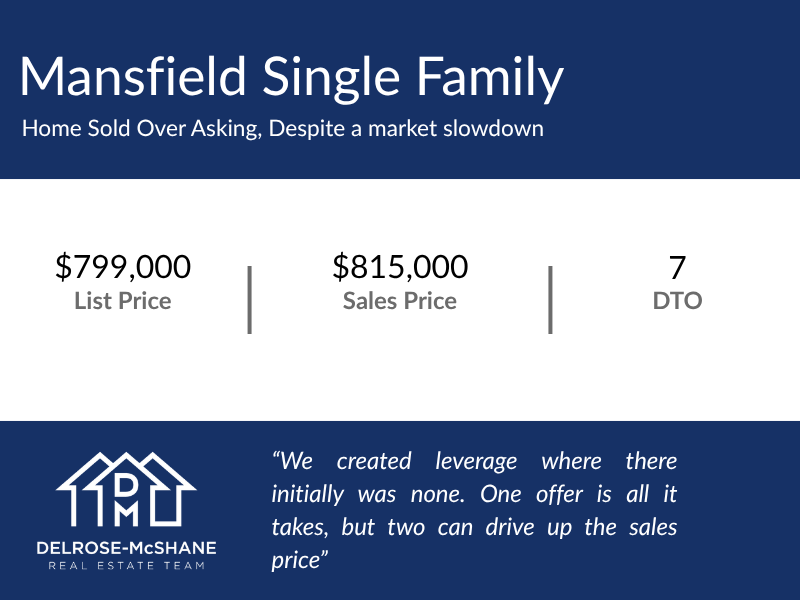
We listed a Mansfield Colonial in late October, priced slightly below where the data suggested, and sold it in seven days for $30,000 over list price. The market around us was slowing. Most sellers in that price band were sitting. Strategic pricing created the competition we needed when the conditions were not handing it to us.
What Does Pricing Strategy Actually Do in a Slow Market?
Most sellers think pricing is about reflecting value. It is. But in a market that is not moving on its own, pricing does something more important. It drives behavior. The right number creates urgency. Urgency creates competition. Competition closes the gap between what a seller hopes to get and what a buyer is willing to pay.
This case study is a direct example of that principle working in one of the harder market environments we have seen in recent years. And it is not a coincidence that the approach mirrors exactly what we did a few weeks earlier with a Waltham condo that drew eight offers and sold nearly 10% above list price. Two different markets, two different property types, the same underlying strategy. At this point we have enough evidence to call it a pattern, not luck.
What Was the Market Doing When We Listed?
We listed 778 Ware Street in Mansfield on October 22, 2025. That timing matters.
The Greater Boston market had experienced a significant late summer and fall slowdown last year. After a strong spring and early summer, activity in many segments pulled back sharply heading into September and October. Buyers slowed down. Inventory sat longer. The urgency that defined earlier months had faded.
We knew going in that this would not be the bidding war environment sellers had benefited from just a few months prior. We set expectations accordingly. The goal was not to time the market perfectly. It was to maximize the outcome given the conditions we were actually working in.
There was also a timing pressure on our side of the table. With Thanksgiving approaching, we understood that if the home did not move in the next few weeks, we would be heading into the holiday period, traditionally the slowest stretch of the real estate year. That created a real sense of urgency around getting the pricing right from day one.
What Made This Home Worth Getting Right?
778 Ware Street is a Garrison Colonial originally built in 1963 and fully rebuilt in 2007. It sits on just under 0.7 acres with 2,202 square feet of finished living space above grade, three bedrooms, 2.5 baths, and a partially finished lower level adding another 200 square feet of usable space.
The kitchen was updated in 2024 with white quartz countertops, a new tile backsplash, stainless steel appliances, and modern lighting. Hardwood floors run throughout. A bonus room over the garage adds meaningful flexible space. The septic was replaced in 2018 and is rated for four bedrooms. Two gas heating systems, two central air zones, and a fully fenced backyard with a Trex deck, stone patio, and fire pit rounded out the package.
This was a well-maintained, move-in-ready home with real updates. It deserved to be sold well.
Why Did We Price Below Where the Data Pointed?
Based on comparable sales, we believed the fair market value sat around $815,000. $800,00 was our floor, and we say other properties sitting as they reached the $820,000 range. Our seller was in the middle of a trade-up, already under agreement on their next property. A slow sale meant carrying two homes through the winter. That was not a comfortable position.
Instead of testing the ceiling at $815,000 or above, we listed at $795,000. The reasoning was straightforward. The $750,000 to $850,000 price band was moving more slowly than both the move-up segment below it and the luxury market above it. Buyers in that range were cautious. They were evaluating. They were not chasing.
We needed to give them a reason to act.
Pricing at $795,000 accomplished two things. It positioned the home as the clear value play among comparable listings. And it created a psychological entry point that made buyers feel like they were getting something, not overpaying in a market that had just softened.
What Happened After We Listed?
Showings began Friday afternoon, per the listing instructions. The first weekend brought activity, but it was measured. One buyer showed serious interest. Then they started going back and forth through their agent.
That hesitation is a signal most agents wait out. We did not.
I called the agent directly. The message was simple: have your client submit if they are serious. You never know if this is going to be your only offer. It only takes one.
That call mattered. The buyer came forward with an offer. Shortly after, a second offer entered the picture.
Now we had something we did not have 48 hours earlier. Leverage.
We moved both parties to final and best. Two motivated buyers competing for the same home, neither willing to walk away. That is the environment strategic pricing is designed to create, even when the broader market is not handing it to you.
What Was the Result?
778 Ware Street went under agreement on October 29, 2025, exactly seven days after listing. Days to offer: 7.
The home sold for $825,000, closing mid December, 2025.
That is $25,000 above list price and $10,000 above where we originally projected fair market value. The sale-to-list ratio came in at 103.77%.
In a market that was behaving like a buyer’s market in that price band, we created a seller’s advantage. The buyers got a home they wanted. Our seller maximized their return and stayed on track for their next purchase, closing before the holidays.
Is This the Same Strategy That Worked in Waltham?
Yes. last week I shared a case study about a Waltham condo that drew eight offers after being priced at the lower end of fair market value. The winning offer came in nearly 10% above list price. Different property type, different town, different price point. The same foundational approach.
Price to create movement. Movement creates competition. Competition drives the outcome.
Two transactions. Two markets. Both times, sellers who trusted the strategy netted more than they would have by testing the ceiling. That is not a coincidence. That is a repeatable process.
What Does This Mean for Sellers Today?
If you are thinking about listing, the instinct to price high is understandable. It feels protective. It feels like you are leaving room to negotiate. But in most market conditions, especially in slower segments or during off-peak timing, pricing high reduces urgency and gives cautious buyers a reason to wait.
The right price does not just reflect what your home is worth. It creates the conditions that determine what you actually get.
You only know the market you are in. The goal is to work it, not fight it.
About the Author
Mike DelRose Jr. is a REALTOR® and Director of Marketing for the DelRose McShane Team at Coldwell Banker Realty in Belmont, Massachusetts. A third-generation real estate professional, he holds a Bachelor of Science in Marketing and a Master of Science in Innovation and Strategic Management from Salve Regina University. He serves on the Greater Boston Association of REALTORS® Board of Directors and chairs the Grievance Committee. Licensed in Massachusetts since 2009.
Data sourced from MLSPIN. This case study is based on an actual transaction closed by the DelRose McShane Team. Results are specific to the conditions and strategy applied in this transaction and are not a guarantee of future outcomes.
