
 Facebook
 X
X
 Pinterest
 Copy Link
By Bobby McShane & Mike DelRose Jr. | DelRose McShane Team | Coldwell Banker Realty
Monday, June 26th, 2026, Watertown, MA.
Buying a multi-family in Belmont, Watertown, or Waltham today is a fundamentally different proposition than it was a decade ago. Prices have moved well past the point where rents cover a standard mortgage payment. That reality is pushing serious investors to think differently, and the ones paying attention are finding real opportunity in what a property can become, not just what it is.
This article accompanies a video case study from Bobby McShane on how one Belmont two-family became something more valuable than the sum of its parts. If you have not watched it, start there. Then come back here.
How Does a Condo Conversion Work in Massachusetts?
A condo conversion is the legal process of dividing a single property into individually owned units. In Massachusetts, this typically involves filing a master deed and a declaration of trust with the registry of deeds. An attorney handles the documents. The process is not complicated when the property qualifies, but it requires the right guidance from the start.
The cost to convert is often modest relative to the value it creates. Done correctly, what was a single asset becomes two or more separately marketable units, each with its own deed, its own financing options, and its own buyer pool.
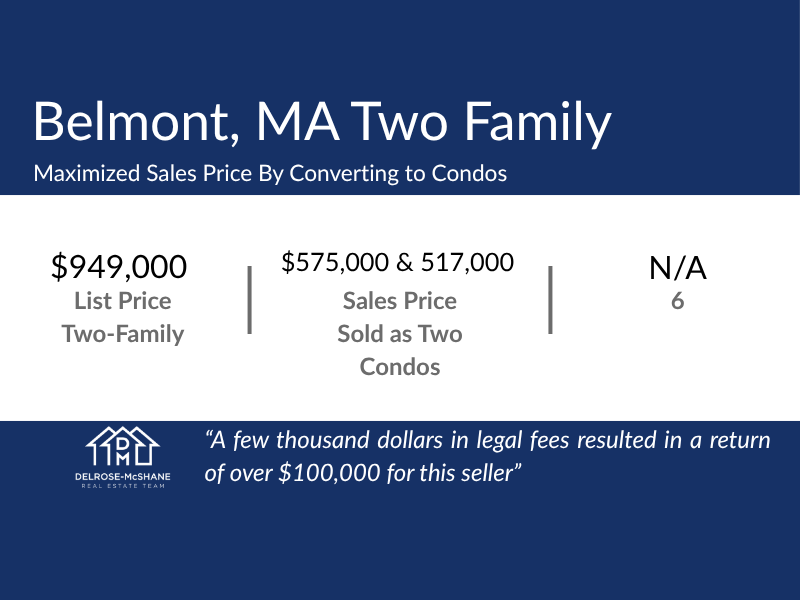
Bobby McShane completed exactly this process in 2020 with a Belmont two-family just outside Cushing Square. The sellers lived on the second floor and owned the whole building. Working with an attorney, they converted the property into two condominiums for a few thousand dollars in legal fees. With some additional preparation work on the property, the outcome was significant. A two-family that would have listed at $949,000 became two separate condominiums, one selling at $575,000 and the other at $517,000. Combined, that is $1,092,000 in gross proceeds from an asset that would have topped out well below that figure as a single transaction.
That gap is not accidental. It reflects something real about how buyers in this market think and what they are willing to pay for.
Why Does Converting Create Value?
Multi-family buyers are investors. They run numbers. They evaluate cap rates, gross rent multipliers, and cash flow projections. That analysis puts a ceiling on what they will pay, and in a market like Belmont, that ceiling sits well below what the real estate itself is worth to a pure investor opposed to an owner occupant.
Condominium buyers are not running those numbers. They are buying a home. They are evaluating schools, commute times, neighborhoods, and finishes. The emotional and financial evaluation is completely different, and it supports a higher price per square foot.
When you split a two-family into condominiums, you are not just dividing a building. You are switching the buyer pool from investors to more owner occupants. That is where the value comes from. In fact, we’re seeing an increase in buyers for owner-occupied multi-families who have multi-generational aspirations.
What Does the Multi-Family Market Look Like Right Now?
According to MLSPIN, Belmont multi-family properties are selling at a median of $1,348,500. Waltham comes in at $1,045,438. Watertown at $1,200,000.
At those price points, with conventional financing and current interest rates, the rents are not covering the mortgage payment for most buyers without a more substantial down payment. That is not speculation. It is arithmetic. A $1.3 million purchase at 6.62% over 30 years with 20% down produces a principal and interest payment around $6,700 per month. Gross rents on a Belmont two-family rarely clear that figure.
What that means for today’s investor is that the multi-family purchase in Belmont is largely an appreciation play. You are buying the land, the location, and the long-term trajectory of the asset. Cash flow, if it comes, is a bonus. Equity is the thesis.
That is not a reason to walk away from the opportunity. It is a reason to think more carefully about how to structure it.
What Are Investors Doing Differently Today?
The investors who are finding traction in this market are not just accepting a property as they find it. They are evaluating what it can become. Three areas stand out.
Condo conversion
Bobby’s example from 2020 is more relevant today than it was then. Prices have risen. The gap between what an investor will pay and what an owner-occupant will pay has widened. The legal and administrative cost of a conversion has not changed materially. The math has gotten better.
Accessory dwelling units
Massachusetts has moved meaningfully on ADU law in recent years. As-of-right, ADU development is now permitted in many communities under the state’s new zoning framework, and Belmont, Watertown, and Waltham are all navigating what that means locally. A detached garage, a finished basement with a separate entrance, or a carriage house can become a permitted unit that adds rental income and appraised value. Investors who understand the current zoning landscape are finding opportunities others are overlooking.
Square footage maximization
Unfinished basements and attic space represent real value waiting to be unlocked. Finishing a basement with egress adds livable square footage and rental potential. A walk-up attic with headroom can become a bedroom, a studio, or in some configurations, a separate unit. The cost per square foot to finish existing space is almost always lower than acquiring new square footage in this market.
None of these strategies work in every situation. The property has to be right. The zoning has to support it. The numbers have to make sense. But the investors asking these questions before they close are the ones who end up with assets that perform.
What Should You Be Asking Before You Buy?
Before making an offer on a multi-family in this market, the right questions are not just about current rents and current condition. They are about what the property permits, what it could become, and what the path to that outcome actually looks like.
What does local zoning allow? Is the lot configured in a way that supports an ADU? Is there unfinished space that could be converted to livable area? Is the building a candidate for condo conversion, and if so, what does the legal and preparation process look like?
These are not complicated questions, but they require someone who knows the market well enough to answer them honestly.
A Final Thought
Bobby’s transaction in 2020 was not an outlier. It was a well-executed strategy applied to the right property at the right time. The market conditions that made it work then are, in many ways, even more pronounced now. Prices are higher. The premium that owner-occupants pay over investors is wider. The opportunity to create value through conversion, ADUs, and smart rehabilitation is real.
The investors who succeed in Belmont, Watertown, and Waltham over the next several years will be the ones who see the property in front of them and also see what it could become. That perspective is something we bring to every conversation about multi-family real estate in this market.
If you want to talk through a specific property or opportunity, reach out. That conversation costs nothing and tends to be worth a lot.
Bobby McShane & Mike DelRose Jr. | REALTOR® | DelRose McShane Team | Coldwell Banker Realty | 130 Concord Ave, Belmont MA 02478 | 617.515.7715 | Homes@DelRoseMcShane.com | Broker #8064
Data sourced from MLSPIN. Market statistics reflect closed sales in Belmont, Watertown, and Waltham.
