
 Facebook
 X
X
 Pinterest
 Copy Link
Quick Answer
Some of the listing photos you are scrolling through show rooms that do not exist. Not staged rooms. Generated ones, with furniture, finishes and sometimes entire features added by software.
Done properly and labeled clearly, virtual staging is a legitimate marketing tool that helps buyers picture an empty space. Done carelessly, it wastes your Saturday and can put a seller and their agent on the wrong side of MLS rules and the Code of Ethics.
Learning to tell the difference takes about five minutes.
Watch: Mike DelRose Jr., Mike Simoni and Bobby McShane on where AI helps in real estate and where it starts causing problems.
Clients have told us a home looked nothing like its photographs. More than once, and increasingly often.
Not messier than expected. Not smaller than it photographed. Different. Enhanced to the point where the room in the listing and the room they walked into did not match.
Nobody wins in that moment. The showing is wasted, whatever trust the buyer had in the rest of the listing is gone, and the seller loses a prospect they will never know they had.
First, the part that is completely legitimate
We want to be careful here, because virtual staging is not the villain.
Empty rooms photograph badly. They look smaller than they are, the proportions read wrong, and buyers struggle to judge whether their own furniture fits. This is a well documented effect. In the National Association of REALTORS® 2025 Profile of Home Staging, 83% of buyers’ agents said staging made it easier for a buyer to envision a property as their future home, and 49% of sellers’ agents reported it reduced time on market.
Physical staging solves that and costs thousands. Virtual staging solves a good portion of it for a fraction of the price, which means sellers who could never afford furniture rental now have access to the same advantage. That is a genuinely good development, particularly for estates, vacant properties and anyone selling on a tight budget.
The rule that makes it work is simple. Say that you did it.
What the rules actually say
MLS PIN, the multiple listing service covering most of Massachusetts, sets a clear standard for photographs. An image may be filed only if it contains, displays and is limited to objective information about the physical attributes of the property or about its location.
A furnished picture of an empty room, offered without a label, does not meet that. The room does not look like that.
There is a second layer for anyone who is a REALTOR®. Article 2 of the Code of Ethics requires avoiding exaggeration, misrepresentation or concealment of pertinent facts about a property. Article 12 requires presenting a true picture in advertising. Those obligations do not pause because a piece of software produced the image.
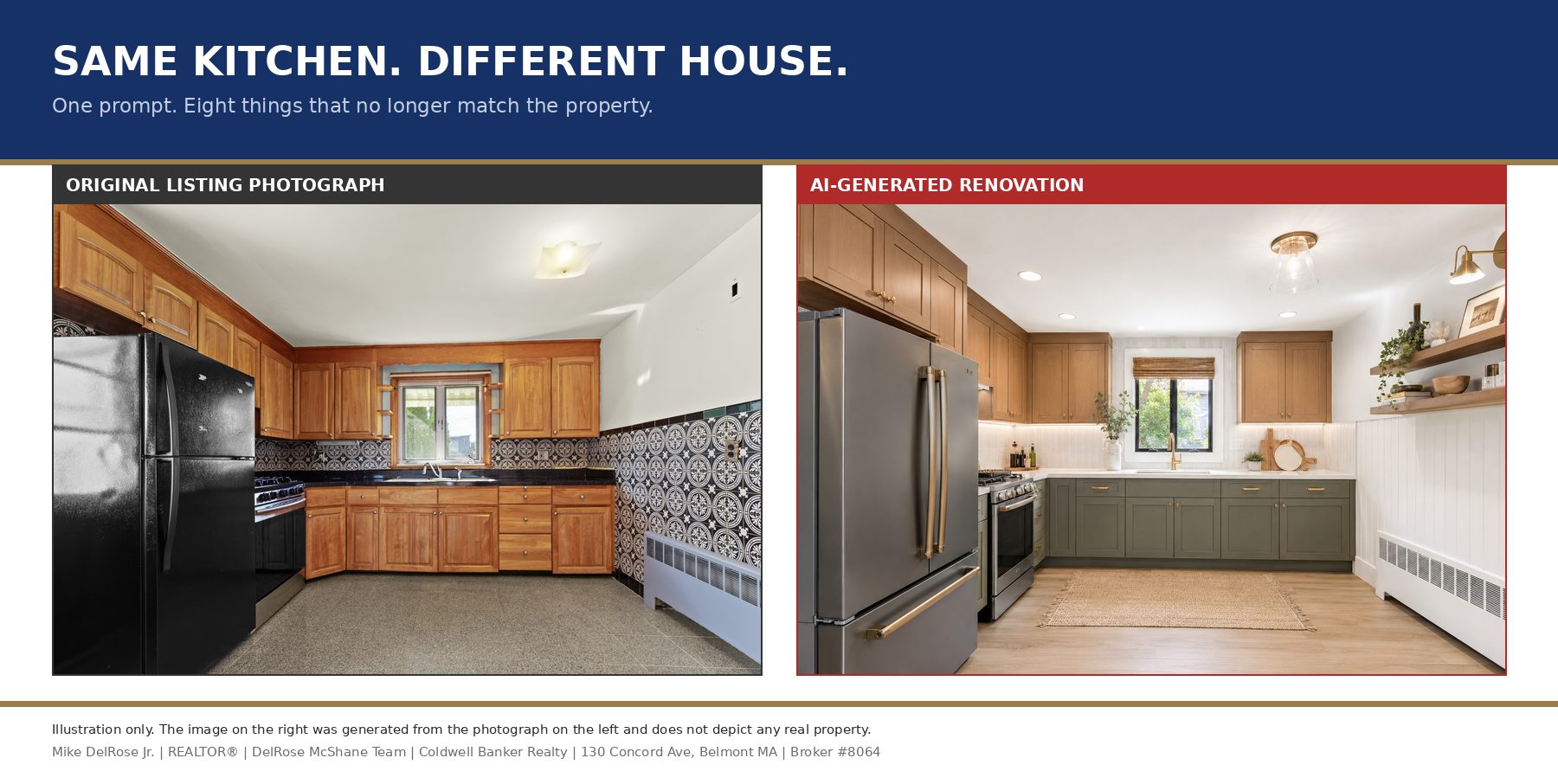
Adding a sofa is marketing. Adding countertops is something else, because the sofa leaves and the countertops stay.
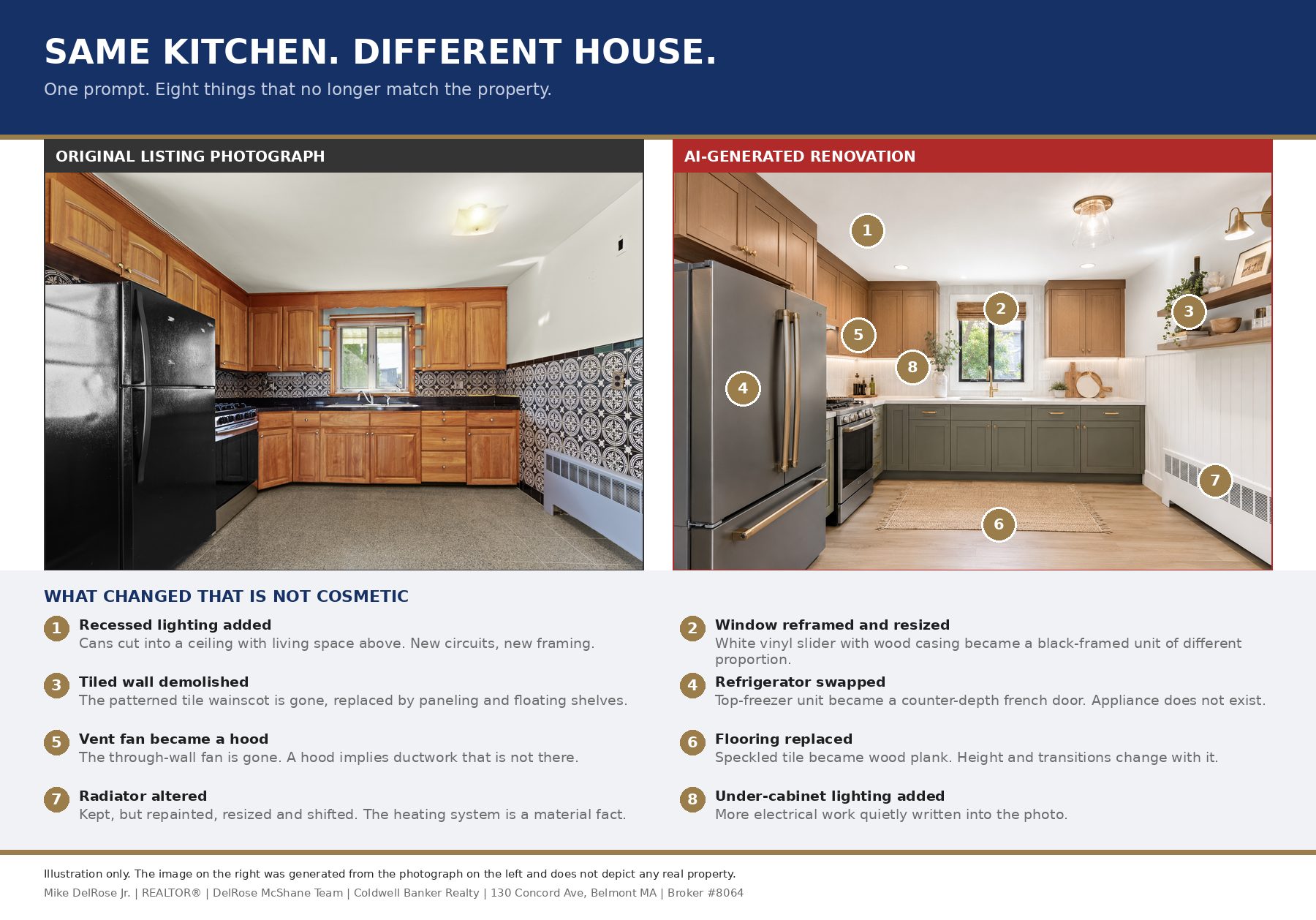
A detailed before and after picture of a kitchen that was generated by artificial intelligence
How to spot it yourself
Once you know what to look for, generated images give themselves away constantly. Here is what our team notices.
Seven tells in listing photos
- Furniture with no shadow. Real objects cast shadows that match the light in the room. Generated ones often float, or cast a shadow pointing the wrong way.
- Things that do not fit the space. A rug running under a wall. A sofa slightly too large for the room it sits in. A dining chair partially inside a cabinet.
- Features in impossible places. Mike Simoni found a listing where a patio had been generated into the back yard sitting directly on top of the staircase to the back door. It went live that way.
- Rooms that change between photos. Compare the kitchen in the wide shot to the kitchen visible through a doorway in another picture. Finishes should match. Sometimes they do not.
- Mismatched resolution. Furniture noticeably sharper or softer than the walls and floor around it.
- Warped straight lines. Look at where the floor meets the wall behind added furniture. Baseboards that bend or vanish are a giveaway.
- Text and detail that dissolves. Book spines, artwork, cabinet hardware and appliance controls that turn to mush under any zoom.
The simplest check of all costs nothing. Look for a floor plan. A floor plan with dimensions cannot be staged, and any listing that has one is telling you something about how the agent operates.
Where AI helps, and where it costs somebody
Photographs are the visible piece, but they are not the only place this shows up. Here is the broader picture for anyone buying or selling right now.
| Use | What it means for you |
|---|---|
| Market data analysis | Faster, deeper pricing research than anyone could do by hand, provided a person who understands the formulas checks the output. |
| Marketing copy | Better written descriptions of your home from agents who are not professional writers, as long as a human edits before it publishes. |
| Image enhancement | Corrects a dim room so the photo matches what your eye sees standing in it. Correction, not creation. |
| Virtual staging | Puts furniture in vacant rooms affordably, opening a tool to sellers who could never justify renting furniture. Must be labeled. |
| Scheduling | Showings booked and confirmed quickly, with fewer missed windows. The least risky use of the whole list. |
| Problem | What it costs, and who |
|---|---|
| Incorrect data | A pricing recommendation built on a miscalculated statistic. A seller lists too high, sits, and takes less than they would have. |
| Fair housing violations | Description language about who should live in a home rather than what the home is. Exposure attaches to the agent and the seller both. |
| Misrepresentation | Unlabeled staging or altered finishes. Buyers arrive, feel misled, and leave. The listing burns showings it cannot get back. |
| Invented facts | Square footage, school or permit details produced rather than looked up. It appears in an advertisement carrying a real license number. |
| Messages nobody read | Automated replies handling a negotiation in a thread the agent never opened. Your position gets communicated by something that does not know it. |
Sellers appear in four of those five rows. This is not only an agent problem.
If you are hiring a listing agent
Ask them directly whether they use these tools, and pay attention to how comfortably the answer comes. Nearly everyone does now. An agent who says no is either behind the market or not being straight with you.
Then get specific. Who reads the listing description before it publishes? Is virtual staging labeled on the photograph itself or buried in the remarks? Does anything that conveys with the house ever get altered in an image? Where do the numbers in the pricing analysis come from?
You are not trying to find someone who avoids technology. You want someone who can tell you precisely where they stop.
If you are the one buying
Treat photographs as an invitation rather than a record. They tell you a property is worth seeing. They do not tell you what is there.
When something looks materially different in person, say so out loud to your agent. It matters for your own decision, and it matters because listing agents generally do want to know when their marketing has misfired. Most of these problems are carelessness rather than intent, and carelessness gets corrected when somebody points at it.
And keep the whole thing in proportion. The overwhelming majority of listings are represented honestly. The point of learning the tells is not suspicion. It is being able to spend your weekends on houses that are actually what they appear to be.
Mike wrote a longer piece on the professional side of this, covering the market analysis errors these tools produce, the fair housing exposure in generated listing copy, and how the Code of Ethics and MLS rules apply: AI in Real Estate Advertising: Powerful Tool, Real Liability.
Want to see how we market a home?
We are happy to walk you through exactly where we use these tools and where we stop. It is a short conversation and it tells you a lot about how any agent works.
Sources
- National Association of REALTORS®, 2025 Profile of Home Staging, released May 2025, based on a February 2025 survey of 1,266 REALTORS®.
- National Association of REALTORS® Code of Ethics and Standards of Practice, Article 2 and Article 12.
- MLS Property Information Network, Rules and Regulations, Section 1.0(f), Filing of Images.
- Fair Housing Act, 42 U.S.C. 3604(c), prohibition on discriminatory advertising.
By Mike DelRose Jr. | DelRose McShane Team | Coldwell Banker Realty
Mike DelRose Jr. | REALTOR® | DelRose McShane Team | Coldwell Banker Realty | 130 Concord Ave, Belmont, MA 02478 | 617.515.7715 | MikeJr@DelRoseMcShane.com | MA License #9515899 | Broker #8064
This article is general information and is not legal advice. It reflects our own observations and does not represent the position of any association, committee or brokerage. Examples described are illustrative and no property, party or licensee is identified. For questions about advertising compliance, fair housing obligations or MLS rules, consult your broker, your association and a Massachusetts real estate attorney.
