
 Facebook
 X
X
 Pinterest
 Copy Link
Quick Answer
You can learn to recognize knob and tube wiring in about ten minutes. Look for white ceramic knobs on basement joists, dark cloth covered wires running alone through open air, and small round holes bored through the framing with ceramic sleeves inside them.
Inside the living space the tells are different. Two prong outlets, outlets mounted in the baseboard instead of the wall, push button light switches, and a fuse box rather than a breaker panel all point at pre war electrical.
Spotting it is something you can do. Judging it is not. That part belongs to a licensed electrician.
Most buyers walk a basement and see storage. Our team walks the same basement and reads the house.
Electrical is one of the few systems in a home that tells you its age out loud, if you know the vocabulary. And knowing it early matters, because in Greater Boston you are often deciding whether to write an offer on a Saturday afternoon with forty other people walking through behind you.
This is not a guide to deciding whether wiring is safe. Nobody should make that call from a phone flashlight, including us. This is a guide to knowing what you are looking at so you can ask better questions of the professionals whose job it actually is.
Before you go looking, read this
Never touch the wiring. Not the wire, not the knobs, not anything connected to them. Old conductors can be energized even when they look abandoned, and the fabric covering that once protected them may be gone.
Do not open the electrical panel. Do not move insulation with your hands. Do not pull on anything to see where it goes. Look with your eyes and a flashlight, and stop there.
Start in the basement and look up
The basement ceiling is where this system is usually visible, because nobody ever finished it. Point a light at the joists and scan slowly across them.
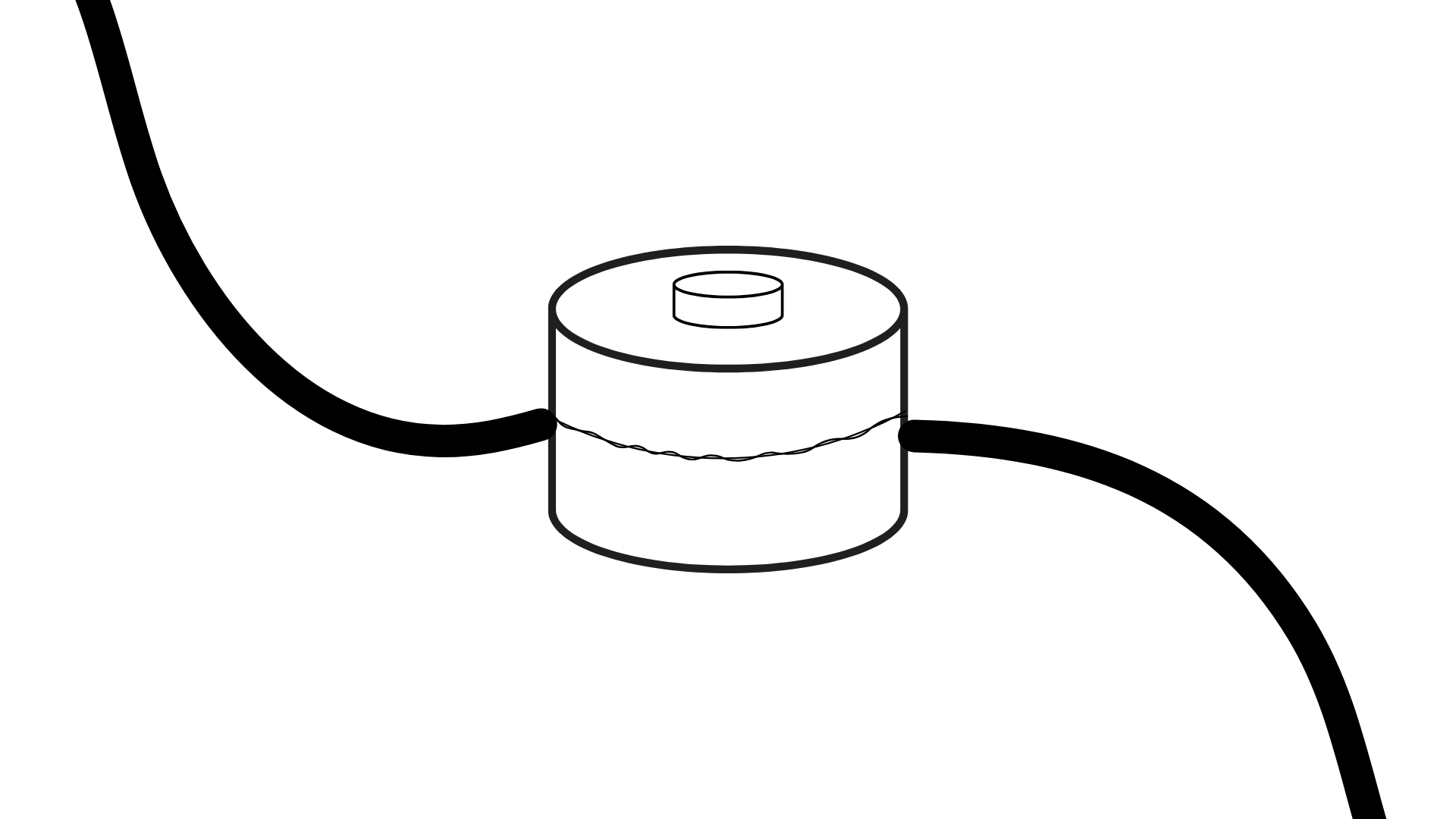
White ceramic knobs. These are the giveaway. Small porcelain cylinders nailed straight into the wood, with a groove around the middle where wire wraps around and gets tied off. They are usually white or a yellowed off white. You will typically see them in a line, spaced out along a joist or a beam, following the path a wire travels.
Dark wire running by itself. Modern cable is a flat plastic jacket, usually white, yellow or grey, carrying several conductors bundled together. Knob and tube looks nothing like that. You will see a single dark strand, often reading black or dark brown, suspended in open air with nothing around it. Then you will see its partner running somewhere else entirely, sometimes several feet away on a different joist. Two wires that never travel together is the pattern.
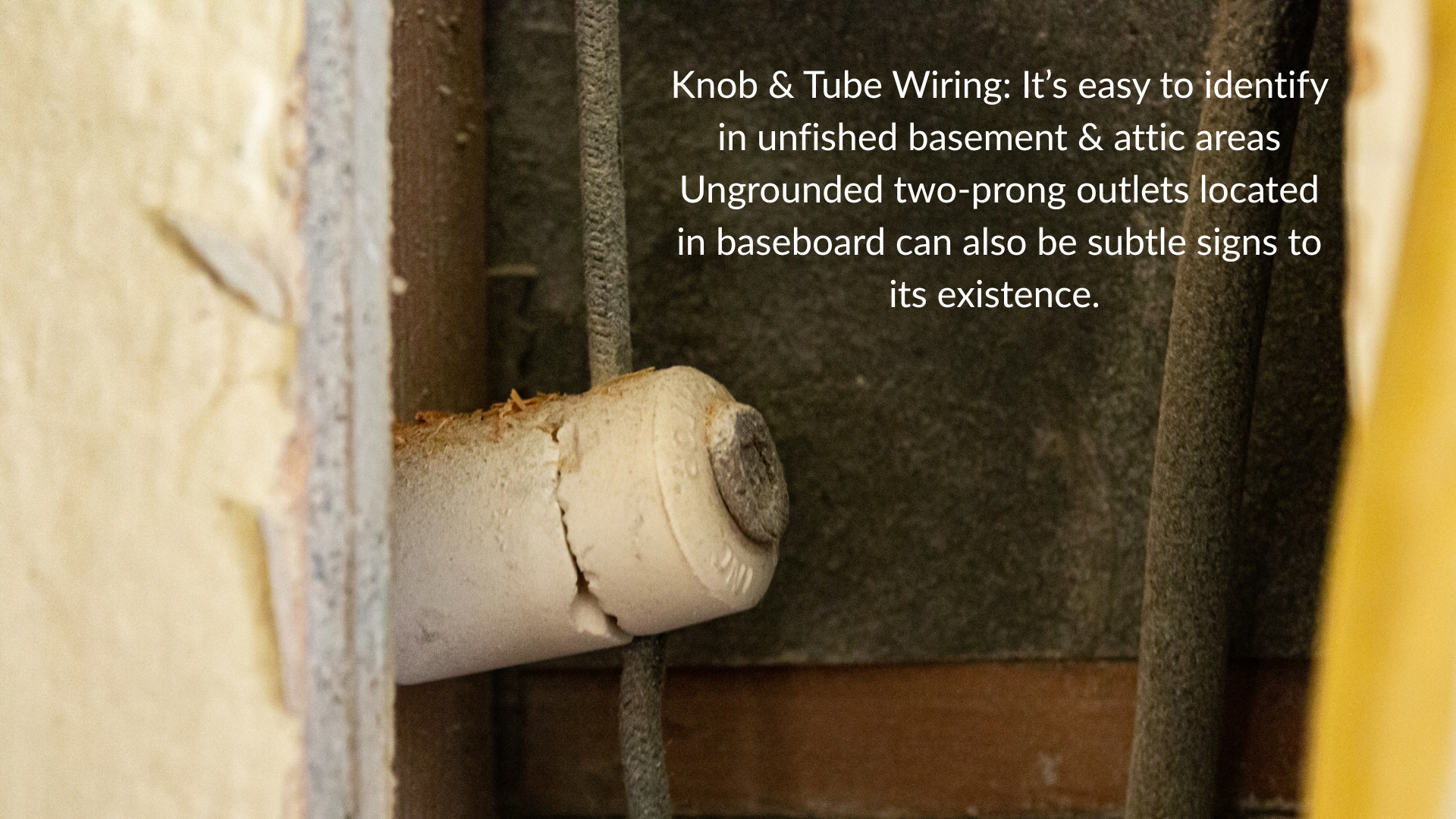
Bored holes with ceramic sleeves. Wherever a wire had to cross through a joist or a stud, somebody drilled a hole and set a ceramic tube inside it so the conductor never touched wood. Look along the sides of the joists for small round holes with a pale liner visible in them.
Empty holes and bare knobs. This one gets overlooked and it is worth more than most people realize. If you see ceramic tubes still seated in joists with no wire in them, or knobs nailed up with nothing wrapped around them, somebody removed wiring at some point. That is a clue about the house’s history. It may mean a previous owner did a partial upgrade. It does not tell you how much of the original system is still live, and that gap is exactly what an electrician gets paid to close.
One caution while you are down there. Larger porcelain pieces sometimes serve a completely different purpose, acting as a pass through for a grounding conductor. They resemble the real thing closely enough that people misread them constantly in both directions. Note what you see and let a professional label it.
Then check the attic
The attic is the second place original wiring survives, for the same reason as the basement. Nobody covered it up.
The complication is insulation. If the attic floor has been insulated, the wiring may be buried underneath it, invisible and inaccessible. That is worth flagging rather than shrugging at, because burying this system creates a specific problem. Knob and tube was engineered to shed heat into surrounding air, and packing insulation around it removes the only cooling it ever had.
Stand at the hatch and look. Do not wade in, do not lift batts, and do not push your hand under loose fill to feel around.
What the finished rooms are telling you
Here is where most people miss the story entirely. You do not need to see wire to find evidence of it. The fixtures and outlets in the living space carry their own history.
Six things to notice while you walk the house
- Two prong outlets. Two slots and no round hole underneath means no grounding conductor at that outlet. Original knob and tube had no ground anywhere in the system.
- Outlets in the baseboard. When electricity arrived in a house built without it, the cheapest path ran along the floor. Receptacles set into the baseboard trim rather than the wall are a strong sign of early retrofit work.
- Push button light switches. Two round buttons instead of a toggle. Charming, period correct, and a clear marker of the era.
- A fuse box instead of a breaker panel. Screw in fuses rather than switches. Also look at the amperage on the main. Sixty amps was normal once and is not close to adequate now.
- Very few outlets per room. One receptacle in a large room, or none at all on an entire wall, reflects a time when a house needed to power a lamp and not much else.
- Cloth covered wire at fixtures. Look up at a ceiling light or into an open junction. Fabric wrapped conductor instead of plastic is worth photographing and asking about.
None of these six prove knob and tube is present. Any of them can appear in a house that was rewired decades ago and simply never had its outlets updated. What they do is tell you the electrical deserves a real look, and they let you say something specific instead of something vague.
The limit of what you can see
Be honest with yourself about this part. The overwhelming majority of a home’s wiring sits inside walls and ceilings where nobody can see it without opening something up.
A clean basement proves very little. Plenty of houses had visible runs pulled out while the concealed portions stayed exactly where they were. The reverse is also true, and it is the more expensive version of being wrong.
What you can see tells you whether to ask. It does not tell you the answer.
Who to call, and what each one actually does
People use these two roles interchangeably and then get frustrated when the answer they wanted does not arrive. They do different jobs.
A home inspector identifies
A licensed home inspector performs a visual, non invasive review of the whole property and reports what is observable. They will note the presence of knob and tube, flag the panel and service size, and identify visible defects. What they will not do is open walls, energize circuits for testing, or hand you a price to fix it. A good inspector will tell you plainly when something needs a specialist, and this is one of those situations.
A licensed electrician scopes and prices
A Massachusetts licensed electrician can determine how much of the original system remains energized, evaluate the condition of what is there, tell you what a remediation would involve, and put a written number on it. If insulation work or an insurance question is in play, they are also the only party who can certify condition in writing. When money is on the line, this is the phone call that matters.
Order matters here. In a typical purchase the inspector goes first, because the inspection contingency period is when you have the leverage and the standing to bring anyone in. If the report flags old wiring, get an electrician into the same house before that window closes.
Questions worth asking
Specific questions get specific answers. Vague ones get reassurance, which is worth nothing.
Ask the electrician
- How much of the original wiring is still carrying current, as best you can tell?
- Has any of it been spliced into modern cable, and were junction boxes used?
- What is the service size, and would a rewire require upgrading it?
- Does this scope pull in other code required work, such as grounded receptacles or hardwired smoke detectors?
- Can this be phased, or does it need to happen all at once?
- Will you put the scope and the price in writing?
That last one is not a formality. A verbal range from a contractor standing in a basement is a conversation. A written scope is something you can act on, plan around, and if it comes to it, negotiate with.
If you own the house rather than shopping for one
The same walkthrough applies, with a different reason for doing it.
Owners who plan to sell in the next couple of years benefit enormously from knowing this before a listing goes up. Every Massachusetts licensee is required by law to present property honestly and to disclose known material defects, and sellers answer questions about their building systems on the Seller’s Statement of Property Condition. Beyond the paperwork, knowing early is simply better leverage. You can get three quotes instead of one, schedule work when it suits you, and decide how to position the house on purpose rather than under pressure.
Owners with no plans to sell should still look, particularly before any insulation or weatherization project. That sequence catches people every year.
The takeaway
Learn two shapes and you have most of what you need. White ceramic knobs on the joists. A dark wire traveling alone through open air. Add the baseboard outlets and the two prong receptacles upstairs and you can read a pre war house faster than most people walking through it with you.
Then hand it off. Identifying is yours. Diagnosing belongs to an inspector and an electrician, in that order.
Greater Boston is full of homes built between 1890 and 1940, and plenty of them are wonderful places to live. Old wiring is not a reason to skip them. Not knowing about it until the wrong moment is.
Wondering what happens to a transaction when this turns up at inspection? Mike covers the insurance and financing side, including why carriers decline policies and what remediation has cost on real deals, in Knob and Tube Wiring: The Insurance Problem Hiding in Old Massachusetts Homes.
Looking at an older home?
We walk these houses every week and we know which inspectors and electricians actually show up. Let’s talk before you write an offer, not after.
Sources
- National Electrical Code, Article 394, Concealed Knob-and-Tube Wiring.
- Washington Administrative Code, WAC 296-46B-394, on written certification of existing knob-and-tube wiring by a licensed electrical contractor. app.leg.wa.gov
- Massachusetts Board of Registration of Real Estate Brokers and Salespersons, Mandatory Real Estate Licensee-Consumer Relationship Disclosure.
By Mike DelRose Jr. | DelRose McShane Team | Coldwell Banker Realty
Mike DelRose Jr. | REALTOR® | DelRose McShane Team | Coldwell Banker Realty | 130 Concord Ave, Belmont, MA 02478 | 617.515.7715 | MikeJr@DelRoseMcShane.com | MA License #9515899 | Broker #8064
This article is general information and is not legal, insurance, engineering or tax advice. It is not a substitute for a professional inspection or evaluation. Do not attempt to test, handle or repair electrical wiring. Consult a licensed Massachusetts electrician for any evaluation or scope of work, a licensed home inspector for property condition, your insurance agent for coverage questions, and a Massachusetts real estate attorney for questions about disclosure obligations and contract terms.
