
 Facebook
 X
X
 Pinterest
 Copy Link

By Mike DelRose Jr. | Wednesday, June 3rd, 2026
Quick Answer
Sometimes the hardest part of buying a home isn’t finding one you love. It’s accepting that the one you love isn’t the right one. In this case, a first-time buyer couple fell hard for a small single-family in Waltham, only to have a home inspection stop the process cold before we even made it upstairs. What felt like a devastating moment turned into the best thing that could have happened to them.
Property & Location Overview
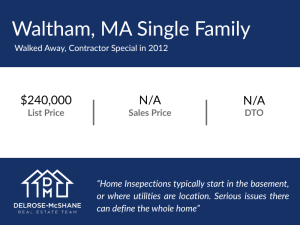
This was a modest single-family home in Waltham, priced in the $200,000s (Wait, how? This was in the early 2010s). Nothing flashy. But it sat close to where the buyers grew up, and that proximity meant something real to them.
That kind of emotional connection to a neighborhood is powerful. It doesn’t show up in a listing description, but it shapes every decision a buyer makes from the moment they walk through the door.
Client Situation
This was a young couple buying their first home together in the early 2010s. They were inexperienced, which is not a criticism. Everyone starts somewhere. What made them vulnerable was what makes most first-time buyers vulnerable: they were leading with their hearts, and the market hadn’t yet taught them to balance that with their heads.
They wanted a home near their roots. That’s a completely understandable motivation. My job was to make sure that motivation didn’t carry them somewhere they shouldn’t go.
Market Conditions
The post-recession buyer’s market was still in full effect. Inventory was up. Sellers had less leverage. Buyers had options and time on their side.
In that kind of market, there is almost never a reason to push through a property with serious problems. The next opportunity is not far away, and the pressure to win at all costs simply doesn’t exist the way it does in a competitive market.
That context matters. The decision to walk away was made easier by the environment we were in.
The Key Challenge
Before we even scheduled the inspection, I had already flagged that the house needed significant work. The condition was visible. The deferred maintenance was real. My honest read was that this was not the right fit for a first-time buyer without renovation experience or a deep reserve of patience and capital.
But buyers sometimes need to see something for themselves before they can truly accept it. That’s not a failure of communication. It’s human nature. My role in that moment was to stay close, stay honest, and let the process do what it needed to do.
The inspection confirmed everything, and then some.
Strategy & Execution
We hadn’t made it past the basement before the weight of what we were looking at became undeniable.
Termites had come through the sill and worked their way into the main carrying beam. That’s not a repair line item. That’s a foundational problem with cascading implications. Structural. Financial. Emotional.
I didn’t have to make the case for walking away. The house made it for me.
What I did focus on in that moment was the couple in front of me. They were visibly shaken. The home they had pictured themselves building a life in had just revealed something they couldn’t unsee. That’s a real emotional experience, and it deserved to be treated as one.
We wrapped up the inspection. We didn’t go upstairs. There was no reason to.
Obstacles During the Process
The obstacle here wasn’t logistical. It was emotional.
Watching a buyer absorb that kind of disappointment, especially on what was supposed to be an exciting milestone, was something that stuck with me. This was early in my career, and it put into sharp focus what this business actually asks of the people in it.
Buyers don’t just hire you to open doors and write offers. They trust you with one of the most significant decisions of their lives. When something goes wrong, even something that ultimately protects them, it still hurts. Understanding that is part of the job.
Outcome
They walked away from the property. No second guessing, no drawn-out deliberation. The decision made itself in the basement of a house that wasn’t right for them.
What came next was better. They found a home they genuinely loved, one without the baggage, without the structural risk, and without the compromise. They bought it, and it was the right fit from the start.
What Made This Different
Two things stand out.
First, the market context. In a buyer’s market with plenty of inventory, there was no reason to force this. Patience was available to them, and we used it.
Second, the emotional dimension. This wasn’t just a transaction that didn’t close. It was a moment where a couple had to grieve a version of their future that didn’t exist yet. That experience shaped how I approach buyer psychology to this day.
Real estate is not just about the deal. It’s about the person making the decision. The house they almost bought would likely have drained them financially and emotionally. The one they ended up with gave them exactly what they were looking for in the first place.
Lessons & Insights
The right house will not require you to talk yourself into it.
When a home inspection reveals something that stops the conversation before it even fully starts, that’s not bad luck. That’s the process working exactly as it should.
First-time buyers are especially susceptible to emotional attachment forming faster than practical judgment can keep up. My job is not to override that emotion. It is to stay alongside it, keep the information honest, and make sure the decision being made is the right one, not just the comfortable one.
In a buyer’s market, time is an asset. Use it.
There is always another house. And in this case, the next one was the right one.
Click Here For A Real Estate Search With Your Guide, Mike DelRose Jr.
Have a question about this situation, general strategy, or something personal to you? Call Me at 617.515.7715
