
 Facebook
 X
X
 Pinterest
 Copy Link
Quick Answer
You can absolutely buy a house without representation. People do it every week and most of them close.
What they give up is harder to see, because it is made up of questions nobody asked, inspectors nobody vetted, terms nobody negotiated, and problems nobody caught early enough to fix cheaply.
Here is what that actually looks like from the other side of the table.
A buyer recently made an offer directly on one of our listings with no agent of their own.
They will probably get the house. They seem like perfectly capable people. And watching the transaction from the listing side has been a useful reminder of how much of this work is invisible until it is missing.
They are not asking the questions we would ask. They did not hire one of the inspectors we see out in the field and trust. They are not negotiating the way we would negotiate on the buying side. And at this point we are genuinely unsure whether anyone is watching the rest of the transaction on their behalf.
The problem with not knowing what you do not know is that the bill arrives later, and by then it reads like bad luck.
None of this is an argument that you cannot do it alone. You do not need an accountant to file taxes or an attorney to draft a will either. It is still advisable, and for the same reasons.
A short history worth knowing
Until the early 1990s, buyers in Massachusetts had nobody. Every agent other than the listing agent was a subagent of the seller, which meant the person driving you around and answering your questions legally owed their loyalty to the other side.
That is not an exaggeration. The Massachusetts Board of Registration of Real Estate Brokers and Salespersons created its first written agency form in 1990, revised it in 1993 to recognize buyer agency, and did not adopt the relationship disclosure used today until 2005.
The push came from consumers. A Federal Trade Commission study in 1983 found most home buyers believed the agent showing them houses represented their interests. They did not. Once states began requiring agents to disclose who they actually worked for, demand for real buyer representation followed.
So when someone buys without an agent today, they are choosing to stand where every buyer stood before 1990. That was a worse deal then and it is a worse deal now.
What gets lost, phase by phase
Before the search. Nobody is asking the questions that refine what you are actually looking for. Buyers who skip that step tend to spend months touring homes that were never going to work, then change their criteria anyway.
Choosing a lender. Nobody is steering you toward the people who return calls and hit deadlines. The cheapest rate quote and the smoothest closing are frequently not the same institution.
Evaluating a property. Nobody is reading the listing by condition rather than by spec sheet, or telling you what this house costs to own five years out versus the one you saw last week.
Writing the offer. Nobody is telling you what a list price actually is, which is a marketing decision rather than a valuation. Nobody is structuring the terms that make an offer competitive without costing you money.
The inspection. Nobody flagged what the inspector was likely to find before you committed, and nobody is negotiating condition afterward. Inspection reports are frightening documents without context.
Everything after. Nobody is tracking the deadlines, chasing the appraisal, or noticing that something routine has quietly become a problem.
The listing agent in that transaction is a professional and will treat an unrepresented buyer honestly. They also owe their duty to the seller. That is not a criticism, it is the job, and it is the same job we do when we are on the listing side.
What we think the role actually is
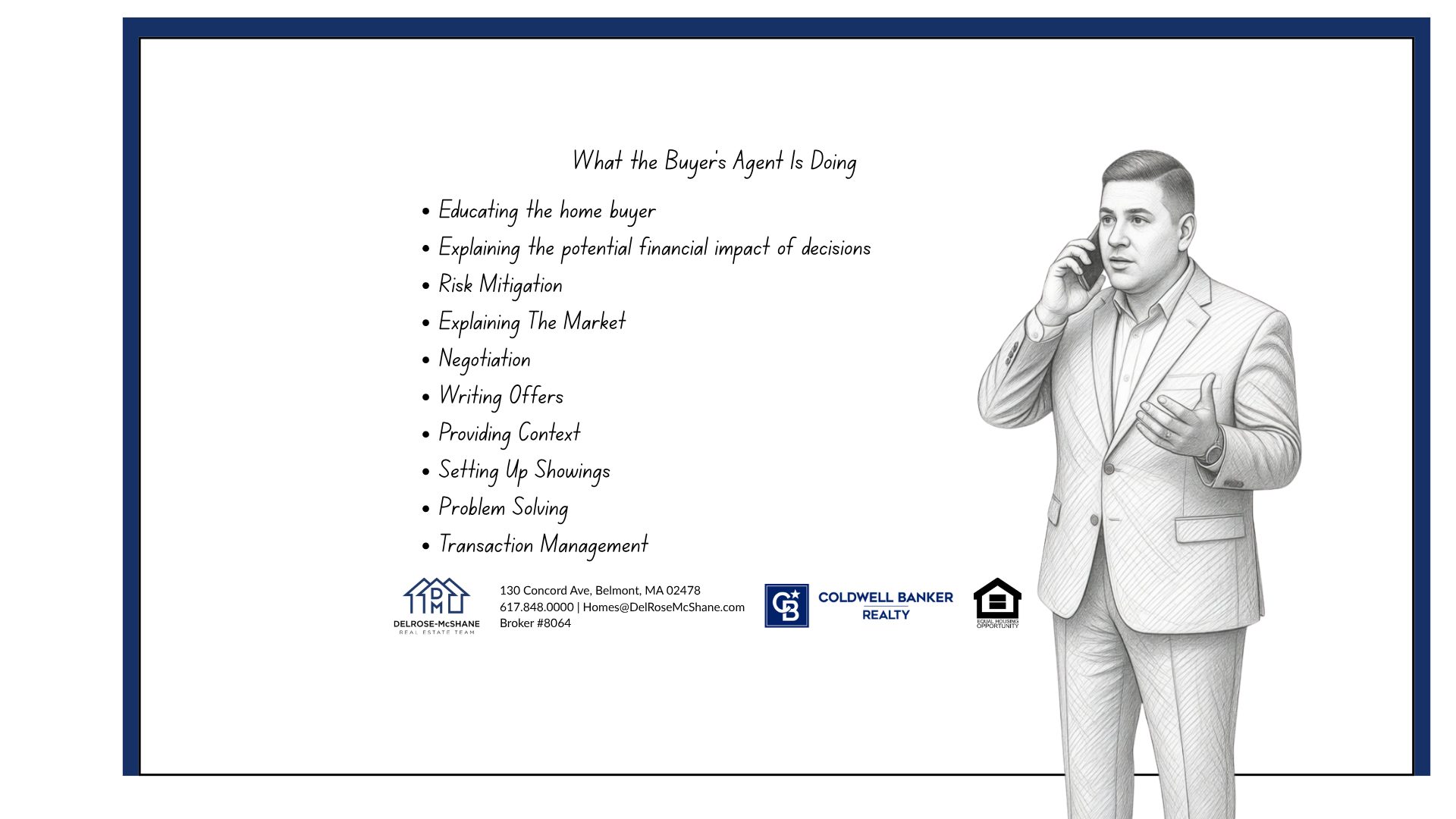
Boiled down to its most elemental form: educate our clients about the process, remove friction from the transaction, and mitigate financial risk.
That covers market knowledge, education, negotiation, objection handling, problem solving, transaction management, and every so often serving as a de facto therapist.
Some of it converts cleanly into dollars. A good chunk of it does not, and those parts are often what clients remember. Reassurance during a search that has gone longer than expected. Context when an inspection report lands and reads like a catastrophe. Knowing which of the fifty things in front of you actually matters this week.
You will not find that on a spreadsheet. You will notice it while you are in it.
Start where our clients start
Savvy Buyers
Our buyer education program covers the Massachusetts purchase process end to end. Financing, market conditions, evaluating a property, offers, inspections and closing. It is the same ground we cover in a first consultation, and you can work through it at your own pace before we ever speak.
Mike wrote a longer piece walking through what a buyer’s agent should be doing at every phase of a search, from the first consultation through the closing table and well after: What a Buyer’s Agent Should Bring to Your Home Search.
Every search starts with a conversation
Tell us what you are trying to do and we will tell you honestly what it takes to get there, including whether now is the right time. No pressure and nothing to decide on the call.
Sources
- Massachusetts Board of Registration of Real Estate Brokers and Salespersons, RE02R24: Buyer Agency. Agency disclosure form timeline, 1990, 1993 and 2005.
- Federal Trade Commission, 1983 study of consumer understanding of agency relationships in residential real estate.
By Mike DelRose Jr. | DelRose McShane Team | Coldwell Banker Realty
Mike DelRose Jr. | REALTOR® | DelRose McShane Team | Coldwell Banker Realty | 130 Concord Ave, Belmont, MA 02478 | 617.515.7715 | MikeJr@DelRoseMcShane.com | MA License #9515899 | Broker #8064
General information only, not legal, tax or financial advice. Every transaction is different. Consult a Massachusetts real estate attorney regarding contract terms and your own advisors before making a purchase decision.
